Company of Heroes
Company of Heroes, a World War II RTS released by Relic Entertainment, features the most detailed garrison system of any game I have played. Unlike Red Alert II or Command & Conquer Generals, troops inside buildings can be hurt by conventional weapons. They receive improved protection but are not invulnerable. Additionally, each building in Company of Heroes offers different levels of protection. Troops in wooden buildings receive less protection than troops in brick building. Larger buildings also tend to offer better protection than smaller ones, particularly from grenades and other anti-garrison weapons.
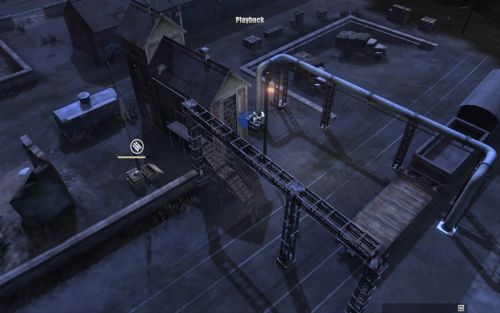
For example, the large brick and metal industrial building in the center of this picture provides great protection for troops inside.
A brief explanation of Company of Heroes squad based infantry system may also be useful. Instead of building individual soldiers you construct a squad of troops which can range in size from two to six individuals. For example, a United States riflemen squad consists of six members. A German Wehrmacht Pioneer unit consists of two members. These squads can be upgraded to have different equipment and weapons as well. For instance, a riflemen squad upgraded with the Browning Automatic Rifle option will have six men wielding three M1 Garand rifles, one carbine, and two BARs.

A two man Pioneer squad with the flamethrower upgrade.
This squad based system is important for assessing the offensive potency of buildings. Unlike in Red Alert II, where every soldier inside a building can fire at attackers, in Company of Heroes every window or other opening allows only one soldier to fire out of it. So if a building has three windows on one side, only three soldiers inside the building can fire out at troops attacking from that side, even if there is a full six man rifleman squad inside. If a building only has one window on a side, only one soldier can fire out from that area. Some buildings have sides with no windows at all-these can be attacked without fear of reprisal by enemy troops. One interesting side note is that some explosive weapons, like tank shells or bazooka rounds, can open new holes in buildings that defenders can fire from.

The building in the lower right of this picture can have up to three soldiers firing out of its left side but only one at a time from its south side.
This is very important to keep in mind both when garrisoning troops and when attacking a building. Troops in the open may be able to defeat garrisoned troops if they attack from a side with few windows and will always win if they attack from a side with no firing ports at all. All of the attacking troops will be able to fire but only one or two of the defenders will be able to return fire. Although the defender is replaced by another member of the squad when he dies, the difference in firepower can be fatal to the defending squad.
If you attack a building from more than one side at once, any extra available soldiers will fire out at the troops coming from the different direction. For instance, if a four man Wehrmacht Grenadier squad is in a building that has two windows on the right side and one on the south side and the building is attacked from those two sides, two men in the squad will fire from the right and one will fire from the south.

The building in the upper left illustrates this point.
Like in Command and Conquer Generals, there are some weapons available in Company of Heroes that inflict extra damage to garrisoned troops. Grenades and flamethrowers are the two most readily available building clearing choices. Grenades can be upgraded or are immediately available for many of the infantry squads for each faction, flamethrowers are an upgrade available for the engineer type units of each faction.
Damage from a flamethrower depends on the size of the building-soldiers in larger buildings will die slower than ones in small buildings. So large metal buildings like the one in the first screenshot on this post will be difficult to kill quickly with a flamethrower team but small wooden shacks will probably result in almost instant death for the squad inside.
Grenades do extra damage to troops in buildings, but it is important to keep in mind that the damage from a grenade depends on where it is flung in the building. If you throw it on the opposite side from where the troops in the building are located it will not do much damage.

As this grenade was hurled right at the enemy machine gun team, it should at least inflict heavy damage to and possibly kill the entire squad.
Garrisoned heavy machine gun squads add a great deal more strategy to buildings in Company of Heroes. When they are in the open they can only fire in a certain arc and take some time to redeploy when they wish to attack troops coming from a different direction. They are also extremely vulnerable to troops coming from behind them. When placed in a building they can fire in all directions that windows are available and receive some protection from enemy fire. Heavy machine guns are devastating weapons because they suppress enemy troops. This causes them to squirm around on the ground, take more damage from fire, and be unable to fight back effectively. HMGs are a great way to slaughter an opponent who relies on massed infantry attacks.

This MG is suppressing a large number of British troops.
However, garrisoned MGs have two major weaknesses. One is that once a target has been acquired they are stuck firing at that target until it is dead, out of range, or out of the arc of fire available from that side of the building. The other is that it takes them a moment to acquire an enemy when they redeploy to a different side of the building. This allows two major strategies to defeat them.
One option is to use one infantry squad as bait-drawing the HMGs fire while other infantry units move from a different direction to destroy it. This can be a quick way to deal with a troublesome MG, particularly if you have grenades or flamethrowers available in the assaulting squads. The main risk of this strategy is that you can sometimes take heavy casualties in the baiting squad or lose the squad altogether. Ideally the squad used as bait will be in some sort of cover so that they are not slaughtered in the open.
The other option is to use the tactic of building circling, where you move a squad right next to the building and run circles around it while the MG has to keep redeploying to try and open fire. This takes a bit of time but the MG will eventually be killed by the circling squad. This strategy will only work if there is an avenue to advance on that has a blocked line of sight for the MG. The other risk is that sometimes one soldier in the squad will lag behind and be hit by the MG, causing his entire squad to be suppressed. If this happens, that necessitates a retreat.

This rifleman squad used the hedge to get close to the building without being engaged by the HMG and are now circling the building.
However, the most important part of the garrison system are that buildings are placed in key strategic locations on the map. Company of Heroes differs from many other RTS games in that players must capture and control points on the map to gain resources rather than use workers to harvest resources. Additionally, they must hold territories linking them to that location. This means that protecting those points from being recaptured by the enemy is extremely important. On many maps, buildings overlook the most valuable resources or the capture points that are required to link a player to those resources. Without that fact, the detail in the garrison system wouldn't be as important to the game. In comparison, Command and Conquer General's maps are usually large enough that there is a direction to attack that bypasses all neutral structures, making it relatively easy to avoid dealing with garrisoned soldiers.
That covers the detailed garrison system of Company of Heroes. Consider how it compares with Red Alert 2 and Command and Conquer Generals. The player who wishes to assault a building is forced to think much like a sergeant or lieutenant on a battlefield would have to. Which side has the most protection for my men? Can we throw a grenade in there? The garrison system adds a lot of tactical depth that is not present in the other systems.
Why is this additional depth important? It goes back to a point that I made about weapon options in FPS games. If there is a single best option for all choices, such as the M16 being unilaterally better than the Famas in Call of Duty Modern Warfare 2, there is no choice to be made. The player who wishes to win will always pick the M16. That is how the garrison system of Red Alert 2 works-the only time you wouldn't want your conscripts to be in a garrison is when there is no building to be found. Command and Conquer Generals added a few weapons that instantly kill garrisoned infantry, a change that meant that buildings wouldn't always be the best choice for the placement of troops. Company of Heroes system has enough detail to keep an entire game going around a key building as each side tries to grab it to use as a strong-point for their position.
The additional fact that these buildings tend to be located near important locations on the map is also critical for its depth. A game that doesn't feature territory control as an element might not need a detailed garrison system, as the optimal strategy would likely be to bypass the buildings when attacking. But when you have to attack a certain position to deny your opponent resources, the system becomes key to gameplay.


