Wednesday, May 18, 2011

Take Some Cover! Garrisons in RTS games Part Two

View Part One

Company of Heroes
Company of Heroes, a World War II RTS released by Relic Entertainment, features the most detailed garrison system of any game I have played. Unlike Red Alert II or Command & Conquer Generals, troops inside buildings can be hurt by conventional weapons. They receive improved protection but are not invulnerable. Additionally, each building in Company of Heroes offers different levels of protection. Troops in wooden buildings receive less protection than troops in brick building. Larger buildings also tend to offer better protection than smaller ones, particularly from grenades and other anti-garrison weapons.
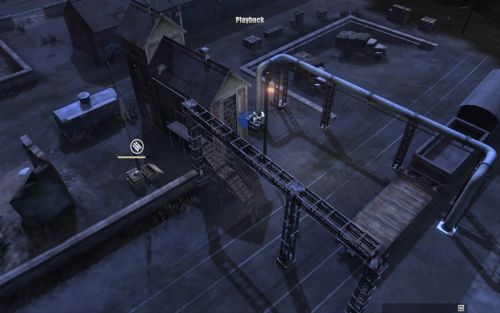

For example, the large brick and metal industrial building in the center of this picture provides great protection for troops inside.

A brief explanation of Company of Heroes squad based infantry system may also be useful. Instead of building individual soldiers you construct a squad of troops which can range in size from two to six individuals. For example, a United States riflemen squad consists of six members. A German Wehrmacht Pioneer unit consists of two members. These squads can be upgraded to have different equipment and weapons as well. For instance, a riflemen squad upgraded with the Browning Automatic Rifle option will have six men wielding three M1 Garand rifles, one carbine, and two BARs.


A two man Pioneer squad with the flamethrower upgrade.

This squad based system is important for assessing the offensive potency of buildings. Unlike in Red Alert II, where every soldier inside a building can fire at attackers, in Company of Heroes every window or other opening allows only one soldier to fire out of it. So if a building has three windows on one side, only three soldiers inside the building can fire out at troops attacking from that side, even if there is a full six man rifleman squad inside. If a building only has one window on a side, only one soldier can fire out from that area. Some buildings have sides with no windows at all-these can be attacked without fear of reprisal by enemy troops. One interesting side note is that some explosive weapons, like tank shells or bazooka rounds, can open new holes in buildings that defenders can fire from.


The building in the lower right of this picture can have up to three soldiers firing out of its left side but only one at a time from its south side.

This is very important to keep in mind both when garrisoning troops and when attacking a building. Troops in the open may be able to defeat garrisoned troops if they attack from a side with few windows and will always win if they attack from a side with no firing ports at all. All of the attacking troops will be able to fire but only one or two of the defenders will be able to return fire. Although the defender is replaced by another member of the squad when he dies, the difference in firepower can be fatal to the defending squad.

If you attack a building from more than one side at once, any extra available soldiers will fire out at the troops coming from the different direction. For instance, if a four man Wehrmacht Grenadier squad is in a building that has two windows on the right side and one on the south side and the building is attacked from those two sides, two men in the squad will fire from the right and one will fire from the south.


The building in the upper left illustrates this point.

Like in Command and Conquer Generals, there are some weapons available in Company of Heroes that inflict extra damage to garrisoned troops. Grenades and flamethrowers are the two most readily available building clearing choices. Grenades can be upgraded or are immediately available for many of the infantry squads for each faction, flamethrowers are an upgrade available for the engineer type units of each faction.

Damage from a flamethrower depends on the size of the building-soldiers in larger buildings will die slower than ones in small buildings. So large metal buildings like the one in the first screenshot on this post will be difficult to kill quickly with a flamethrower team but small wooden shacks will probably result in almost instant death for the squad inside.

Grenades do extra damage to troops in buildings, but it is important to keep in mind that the damage from a grenade depends on where it is flung in the building. If you throw it on the opposite side from where the troops in the building are located it will not do much damage.


As this grenade was hurled right at the enemy machine gun team, it should at least inflict heavy damage to and possibly kill the entire squad.

Garrisoned heavy machine gun squads add a great deal more strategy to buildings in Company of Heroes. When they are in the open they can only fire in a certain arc and take some time to redeploy when they wish to attack troops coming from a different direction. They are also extremely vulnerable to troops coming from behind them. When placed in a building they can fire in all directions that windows are available and receive some protection from enemy fire. Heavy machine guns are devastating weapons because they suppress enemy troops. This causes them to squirm around on the ground, take more damage from fire, and be unable to fight back effectively. HMGs are a great way to slaughter an opponent who relies on massed infantry attacks.


This MG is suppressing a large number of British troops.

However, garrisoned MGs have two major weaknesses. One is that once a target has been acquired they are stuck firing at that target until it is dead, out of range, or out of the arc of fire available from that side of the building. The other is that it takes them a moment to acquire an enemy when they redeploy to a different side of the building. This allows two major strategies to defeat them.

One option is to use one infantry squad as bait-drawing the HMGs fire while other infantry units move from a different direction to destroy it. This can be a quick way to deal with a troublesome MG, particularly if you have grenades or flamethrowers available in the assaulting squads. The main risk of this strategy is that you can sometimes take heavy casualties in the baiting squad or lose the squad altogether. Ideally the squad used as bait will be in some sort of cover so that they are not slaughtered in the open.

The other option is to use the tactic of building circling, where you move a squad right next to the building and run circles around it while the MG has to keep redeploying to try and open fire. This takes a bit of time but the MG will eventually be killed by the circling squad. This strategy will only work if there is an avenue to advance on that has a blocked line of sight for the MG. The other risk is that sometimes one soldier in the squad will lag behind and be hit by the MG, causing his entire squad to be suppressed. If this happens, that necessitates a retreat.


This rifleman squad used the hedge to get close to the building without being engaged by the HMG and are now circling the building.

However, the most important part of the garrison system are that buildings are placed in key strategic locations on the map. Company of Heroes differs from many other RTS games in that players must capture and control points on the map to gain resources rather than use workers to harvest resources. Additionally, they must hold territories linking them to that location. This means that protecting those points from being recaptured by the enemy is extremely important. On many maps, buildings overlook the most valuable resources or the capture points that are required to link a player to those resources. Without that fact, the detail in the garrison system wouldn't be as important to the game. In comparison, Command and Conquer General's maps are usually large enough that there is a direction to attack that bypasses all neutral structures, making it relatively easy to avoid dealing with garrisoned soldiers.

That covers the detailed garrison system of Company of Heroes. Consider how it compares with Red Alert 2 and Command and Conquer Generals. The player who wishes to assault a building is forced to think much like a sergeant or lieutenant on a battlefield would have to. Which side has the most protection for my men? Can we throw a grenade in there? The garrison system adds a lot of tactical depth that is not present in the other systems.

Why is this additional depth important? It goes back to a point that I made about weapon options in FPS games. If there is a single best option for all choices, such as the M16 being unilaterally better than the Famas in Call of Duty Modern Warfare 2, there is no choice to be made. The player who wishes to win will always pick the M16. That is how the garrison system of Red Alert 2 works-the only time you wouldn't want your conscripts to be in a garrison is when there is no building to be found. Command and Conquer Generals added a few weapons that instantly kill garrisoned infantry, a change that meant that buildings wouldn't always be the best choice for the placement of troops. Company of Heroes system has enough detail to keep an entire game going around a key building as each side tries to grab it to use as a strong-point for their position.

The additional fact that these buildings tend to be located near important locations on the map is also critical for its depth. A game that doesn't feature territory control as an element might not need a detailed garrison system, as the optimal strategy would likely be to bypass the buildings when attacking. But when you have to attack a certain position to deny your opponent resources, the system becomes key to gameplay.

Friday, May 13, 2011

Take Some Cover! Garrisons in RTS Games-Part One

Many RTS games allow the player to put infantry into buildings on the map to give them some additional protection from enemy fire and occasionally some combat bonuses such as faster firing times or additional range. Some games are more successful at making buildings a useful strategic element than others. This article will take a look through some of the efforts to make neutral buildings into a tactical choice and see which methods are the most effective.

Age of Empires II
Although probably not the first game to allow the player to garrison units, it is the first I played with the option. Every player starts the game with a Town Center, the basic core of your base that produces the workers needed to gather resources and construct other buildings. When an enemy attacks, the player can sound the alarm at the town center and all nearby workers will enter it to take cover. Additionally, they will fire arrows at enemy units in the area.


A garrisoned town center, indicated by the flag on top.

This is a clever way to prevent one problem that irks many players, the rush. Rushing is when one player produces a large number of a basic combat unit and attacks the other player as soon as possible in the game. If the other player has not invested sufficient resources in his own military, they will either lose everything or lose most of their workers and production capabilities, giving the rushing player an easy win. For instance, one all-in strategy for Warcraft II was to build a barracks as close as possible to the other player's base and produce a couple basic infantry units to kill all of their workers in the first few minutes of the game.

With the ability to garrison the town center, it is much more difficult to achieve an all-out victory with a rush in Age of Empires II. While the workers are still quite vulnerable, the town center itself is extremely difficult to destroy without siege weapons or overwhelming numbers, which are impossible to acquire in the early game. An attempt to destroy the town center with militia-the most basic infantry unit of Age of Empires II-will only result in a large number of arrow riddled corpses outside the building.

However, only workers can attack from the town center. All other infantry units can be garrisoned but they cannot attack while inside buildings. This means that if a player chooses to protect his workers in the town center they will not be harvesting resources. This can put a player at a long term resource disadvantage that will eventually lead to a loss.

Red Alert II
Red Alert II added neutral buildings on the map that could be garrisoned by basic infantry units: the GI for the Allies, Conscript for the Soviets, and Initiate for the Yuri faction added in the expansion. This causes the building to be covered in barbed wire and to take the player's color, allowing the opposing player to know that it is garrisoned. When not inside a building, these units are fairly weak and vulnerable. They don't do great damage, die fairly easily, and can be run over by tanks and other heavy vehicles.


Any of these white buildings can be garrisoned.

When placed inside a building they are immune to enemy fire, the only way to kill them is to destroy the building entirely. Additionally, they do additional damage and fire more rapidly. This bolsters these humble units to the point that they can defeat enemy tanks and throw back enemy assaults. The opposing player also does not know how many infantry units are in the building without attacking it. Some buildings can hold ten or more troops inside but whether there is one or ten inside it will look the same to the enemy player. The only way to learn how many troops are actually occupying it is to move a unit within firing range and see how much fire it takes.


A building garrisoned by GIs-note that it is blue to denote that the allied player has troops inside.

A couple fully garrisoned buildings in the right location can make a direct attack impossible without heavy casualties. This can allow a player to build a few cheap infantry units to protect their base while they focus all of their resources on building more advanced units, such as heavy tanks, aircraft, or superweapons. The only reliable ways to attack garrisoned buildings are with air units and long range weapons. These can attack and eventually destroy the building without taking any damage.


Burning building-the external indicator that it has taken damage.

Once destroyed, the building is gone forever and cannot be rebuilt. This means that if a player allows the enemy to destroy the neutral buildings around their base they lose that source of defense forever. Buildings can be repaired back to full health by the engineer unit if they are reached before they are destroyed though.

The Yuri's Revenge expansion also offers one new garrison feature for the Yuri faction-the tank bunker. These allow the tanks of the Yuri faction to be placed inside a thick shell which can absorb a ton of damage and can also be repaired while it is under attack. As the main tanks of Yuri's faction are weaker than their Allied and Soviet counterparts, this can help them stand up to an enemy tank assault.


This may be an excessive use of tank bunkers.

It is interesting to note that Red Alert II has many more infantry units available, including snipers, anti-aircraft troops, and hero units, but only the basic infantry troops can be garrisoned. This may have been a balance choice or a problem of programming different types of units attacking from the buildings.

Command and Conquer Generals
Command and Conquer Generals adds a few new features to the Red Alert II system. All types of infantry units can be garrisoned, not just basic infantry. As every side has access to rocket infantry this greatly improves the ability of buildings to hold off tank assaults.


US rangers making a chopper-borne assault on an enemy garrisoned building.

This is blunted somewhat by a great versatility of counters to infantry in buildings. Each side has access to at least one method that kills garrisoned troops easily. China has access to dragon tanks, which have a flamethrower that will instantly kill all troops in a building. The Global Liberation Army has toxin tractors that shoot out anthrax sprays that have a similar effect. The United States can upgrade their rangers to shoot flashbang grenades, which also instantly kill garrisoned troops they hit. Rangers can also be placed in Chinook helicopters to conduct airborne assaults, as pictured earlier.


Rangers firing flashbangs at an enemy angry mob.

These additions make the choice to garrison buildings a little more difficult for players. Garrisoning makes troops invulnerable to damage from conventional weapons until the building is destroyed but it also adds the risk of being instantly killed by the correct counter weapons. This gives the option a bit more depth than Age of Empires or Red Alert, as it is not always a great idea to place your infantry in nearby buildings. Unless, of course, you want them burnt to death.

Continue to Part Two, which discusses Company of Heroes.

Monday, May 9, 2011

Infestation-Part Four

Start from the Beginning
View Part Three

Day Three

Wilson and Hotchkins arrived back at the colony early the following morning. Almuda’s men were still awake, watching the horizon along with Diego and Mulheeny. Evidently the two Goliath pilots had been permitted to rest, their walkers were idling outside the command center. Wilson parked his Vulture outside the barracks and walked over to Almuda.

“Anything to report?”

“No sir. Haven’t seen a thing on the horizon.” Although Almuda’s voice still sounded strong, Wilson noticed exhaustion evidence across Almuda’s face.

“Get your men some rest. You won’t do much good if you fall asleep on top of your rifles. We’ll wake you if anything appears.”

“Yes, Sir!” Almuda waved his men over and they departed for their bunks in the barracks.

“What about us!” yelled Mulheeny, who had overheard the conversation. He pointed a finger aggressively at Wilson’s faceplate. “We’ve been up a whole day!”

“After Almuda comes back you’ll be relieved,” said Wilson irritably. This was the last thing he needed after barely escaping the Zerg nesting site.

“You must be kidding, you’ll let the convicts rest first?”

“Convicts or not, they’re more professional than you’ve ever been. They aren’t even paid. Earn your salary for once and do some work around here,” Wilson shoved past Mulheeny and headed toward Hackken’s office. Mulheeny growled, but resumed his post facing the western flank of the outpost. Mulheeny always acted tough but never stood behind his words when it counted.

Wilson stormed down the metal corridor leading to Hackken’s office. The man had been a barricade to getting proper military support for months, offering flimsy excuses for why he could not secure the resources needed to safeguard the mining operation. Wilson would be damned if he let him doom them all to a Zerg assault. He slammed open Hackken’s door, causing a resounding boom as it impacted the wall.

“Are we getting support or not?” demanded Wilson. “I don’t want any more diplomatic answers. I want the truth. Are my men going to be stuck out there hoping that we can kill all the Zerg before we run out of ammunition? Or will we have Combine troops and air support? I need to know how many body bags to order in the next shipment.”

Hackken leaned back in his chair, offering a placating smile. “I’ve done all I can. I explained the situation to the Combine, but they don’t feel that a serious threat is represented by the Zerg forces that you’ve uncovered so far. They need more evidence.”

Wilson slammed his fist on Hackken’s desk, his armor creating a sizable dent in the metal surface. “There’s no more evidence that we can give until they start hammering us. Do they want to wait until we all die? I guess that might show that the Zerg held hostile intentions. You need to decide if you want your life to be ended at the claws of one of those beasts because you didn’t have the guts to demand the support we need.”

Wilson’s suit radio sputtered, interrupting his invective.

“Sergeant, this is Mulheeny. There’s a horde of creatures approaching us.”

Wilson sighed, “Define horde.”

“A lot. Some of them look bigger than the ones we’ve seen so far. The other sides of the base are clear for now, just moving on the western perimeter.”

“Roger, I’ll be right out.” Wilson changed his radio to the emergency signal band. “This is Sergeant Wilson. We are under attack by a large number of hostile alien creatures. All military personnel report to your stations, civilians report to the shelters.”

He closed off the transmission and pointed a finger at Hackken. “I suggest you decide if you want to accept the Combine’s decision within the next ten minutes. We may not have time to reevaluate it later.” He gave a final glower at the smaller man and then rushed outside, readying his rifle as he ran. The two Goliath pilots were rushing toward their vehicles alongside him, already suited up in green coveralls and breathing masks.

“Position your vehicles behind my marines to provide supporting fire,” ordered Wilson. “We’ll be setting up a defensive line in front of the command center. That way the warehouses and barracks will cordon them into a narrower line of fire.”

“Yes, Sir,” said one of the pilots with a nod. When they exited the building, the two men opened the hatches to their vehicles and leaped inside. Wilson looked around to assess the situation. He noticed the colony’s siege tank parked to the side of the commander center and cursed. Hackken had never gotten around to getting a pilot and gunner for the vehicle. It may as well have been taken apart for scrap metal for all the use it was going to do the colony now.

Putting the tank out of his mind, Wilson moved to where his six Marines were preparing a defensive position, Almuda keeping an eye on the advancing Zerg while the rest were setting up barricades and placing extra ammunition magazines within easy reach. The two goliaths stepped into position behind the improvised defensive line.

“Are they moving yet?” asked Wilson.
“Not yet, Sir,” said Almuda. “Soon though. They’re getting arranged to charge.”

Wilson zoomed in on the enemy formation with his suit’s magnifier. Sure enough, a line of the smaller creatures was forming up in front. However, behind them was a line of larger beasts that he had not seen before. They had a coiling body that supported an armored head about two meters off the ground. Two piercing eyes framed the monster’s cruel jaw ringed with sharp, white teeth. One of the creatures flexed its thickly muscled arms to bring two wicked claws into view. It seemed to be giving Wilson a sadistic smile, promising hours of torment ahead. Wilson swallowed nervously. The beast gave a bellowing roar that sent the smaller Zerg lunging hungrily forward toward the marines.

“Hold fire till they reach the barracks!” commanded Wilson. The swarm was already halfway there. Fifty meters, forty meters, thirty, twenty, ten. “FIRE!”

The marines opened up with their Gauss rifles, spraying a fearsome barrage across the rampaging Zerg. A few of the leading beasts collapsed to the ground, but their pursuing brethren continued to approach. The Marine’s rounds just weren’t penetrating the carapaces well enough.

“Fire at will, Goliaths!” radioed Wilson to his support.

The fearsome autocannons let loose with a roar. The heavy rounds sliced right through the small Zerg creatures, leaving puddles of gore in their wake. Wilson’s squad focused on cleaning up the stragglers that the goliaths missed, using aimed bursts to conserve ammunition.

One beast that evaded fire lunged clear over the metal barricade they had erected to pounce on Diego. Its claws went right through Diego’s combat suit, leaving spatters of blood as they withdrew. Wilson snapped off a burst into the creature’s head, knocking it off Diego. He rushed over and put two more bursts into its body to make sure that it was dead.

“Diego!” yelled Wilson, slapping a fresh magazine into his rifle. “How bad you hit?”

“I’ll manage, Sergeant,” coughed Diego wetly, standing up precariously. “Not much else I can do.”

Wilson had no time to spare for Diego as another wave of Zerg charged over the corpses of the first. The Goliaths were firing shorter bursts, leaving far more creatures for the infantry to take down. Several reached the barricade, jabbing their claws and fangs into it to try and bring it down. Mulheeny swung his rifle like a club to try and knock them back. One of the Zerg crawled over the wall and swung a claw into his armor’s right shoulder joint, slicing cleanly through. Mulheeny fell to the ground beside his arm, screaming in agony.

Corporal Almuda moved forward to fill the gap, shooting precisely through the skulls of the nearest Zerg. Following his example, the rest of the Marines focused on hitting the creatures in the head, the one area that they seemed to mind getting hit. As the wave began to evaporate, Wilson ducked behind the barricade and reloaded his rifle. One magazine left. He stood up and nearly dropped his rifle in shock.
Six of the larger creatures were arrayed in a line facing the marines. Apparently they had used the smaller ones as a distraction to get themselves in position. The carapace plates near their shoulders split open to expose several large pouches on their body. Their fangs were bared in a fierce smile, relishing the fear they spread.

“Get down!” yelled Wilson, diving behind the cover of the barricade.

The massed impact of dozens of projectiles rang off the metal plate shielding Wilson. Diego, slowed by his injury, fell down heavily beside him, his faceplate and upper armor covered in long spines that had burst right through. Cursing, Wilson looked up and down the line to see who was left standing. One of Almuda’s men lay on the ground, another victim of the fearsome projectiles. Mulheeny was no longer moving. Great, down to four men.

“Up, fire back!” yelled Wilson, moving up to a crouch to fire his rifle. The remaining Marines joined him, hammering the line of Zerg with ammunition. It didn’t have much effect; most of the rounds deflected harmlessly off the creature’s thick shells. One of the creatures collapsed when it was hit by a stream of autocannon fire, but it seemed that the Goliath’s fire was ebbing. Wilson glanced back quickly to see why. A Goliath had fallen on its side, flames jetting out of the cockpit. One of its fuel lines must have been hit. Their position was looking better every minute.

Another volley of spikes filled the air, forcing Wilson to duck. He heard a grunt to his left and saw Almuda’s other marine collapse. Wilson reloaded his weapon with his last magazine. If he was going to die here, he wasn’t going to do it cowering behind a piece of scrap metal. Heart racing, he prepared to charge the Zerg. Maybe at a closer range his rifle could penetrate their carapace, taking one of them down with him.

A deafening blast sent Wilson reeling to the ground in shock. He shakily rose to his feet and turned toward the Zerg’s position. A massive crater filled with gore was all that was left. Wilson looked around in puzzlement, Hotchkins and Almuda rising beside him.

“I thought you could use the reinforcements,” said Administrator Hackken smugly over Wilson’s radio.

Wilson gazed up and saw several green Combine dropships setting down outside the colony, discharging Marines, Goliaths, and other equipment. One of them had set down a Siege Tank, one of the new models that could reconfigure into an artillery piece on the field. The powerful round had taken out all the remaining Zerg in one blast.

“I appreciate the help, Hackken,” said Wilson. “We were about to be finished off.”

“That’s the nicest thing you’ve ever said to me, Sergeant.”

“I’ll try not to make a habit of it.”

Wilson sighed, looking about at the devastation the Zerg attack had wrought. Only Hotchkins and Almuda remained of his command. Maybe the Combine would give him some reinforcements once they had finished driving the Zerg off the planet.

“I’m glad that’s over, Sergeant,” said Hotchkins.

“The battle is over,” said Wilson. “The war has just begun.”


In retrospect that last line is really cheesy. Oh well. I hope you enjoyed the story.

Thursday, May 5, 2011

Infestation- Part Three

View Part One
View Part Two

Wilson marched to the command center to enter Hackken’s office. Maybe he would have some more information about what they were facing by now. He knocked on Hackken’s door. When no answer was forthcoming, he opened it and peered inside. Hackken held his head in his hands, leaning on his desk.

“I didn’t say you could enter,” said Hackken softly.

“I have something important to report,” said Wilson. “On my patrol my squad was attacked by the same sort of insectoid creature that was reported on Mar Sara. It was waiting underground for us near the dead civilian. The base was also attacked while we were gone, although I expect you already know about that. I’m concerned for the colony’s security. I think we need to ask for additional forces from the Combine to help us secure the moon.”

Hackken sighed, but made no other answer.

“Sir, by the time these creatures were sighted on Mar Sara there were thousands of them. I think it’s safe to assume that there are more of them out there. My men won’t be enough if more of them come to attack us. The four that hit the base earlier could have just been a scouting party.” Wilson waited for Hackken’s reply.

“They’re called the Zerg,” said Hackken after a long pause. “They’re far more dangerous than you realize, Sergeant. The situation on Mar Sara is growing severe. The Confederacy has ordered the outlying colonists to be relocated to more secure areas, but many of the smaller installations have already been overrun. The Combine’s intelligence operatives think they will overrun the planet soon.”

“Then isn’t it even more important that we get support here?”

“I’ve already requested it. It was denied. My commanding officer wants more evidence that there’s a significant Zerg infestation here before they devote forces to the area. Keep in mind that we have no idea if the Protoss or Zerg are going to rampage throughout our other holdings. We need solid signs of a credible threat before we will get any reinforcements.”

“We’ve already lost one Marine in an attack on the colony! What more do they want?”

“Evidence of a hive cluster. The Zerg seed worlds with some sort of organic material that they use to grow and nourish themselves on. It’s been named the creep.”

“The creep?”

“It’s like a living carpet. It spreads outward from organic structures they grow on the surface of planets. It’s essential for their colonies to grow. Modified sensor scans show that more than thirty percent of Mar Sara has been covered with it. I think if you can find some of this material on Pyrux, that will be convincing enough evidence for me to get some reinforcements sent here.”

“Any idea where I should start looking?”

“If I knew that, I’d already have called in more troops,” said Hackken impatiently, directing a disgusted frown at Wilson. “I suggest that you take the Vultures out and see if you can find where the Zerg patrols came from.”

“Fine. If I’m not back by tomorrow morning and don’t radio in, you can consider me dead. Anything else?”

“No. Considering how fast they spread throughout Mar Sara, if they did create a hive cluster here, it may already be far too late.”

Wilson made a quick salute and rushed outside the command center, grabbing the ignition keys to both Vultures from the rack outside Hackken’s office as he left. His squad was still meandering outside the building.

“Hotchkins! We’re going for a ride,” yelled Wilson. He threw a key at Hotckins, who bobbled it in the air before catching it.

“Where to?” asked Hotchkins, hurrying to match Wilson’s brisk pace.

“To find where those creatures came from. Hackken believes they have a large colony somewhere on the moon. You’ll know it by the presence of a field of organic material on the soil. Let me know immediately if you see anything.”

Wilson jumped astride one of the colony’s two Vultures, settling back in the comfortable padded seat. Hotchkins mounted the other bike, inserting the key into the ignition. The Vultures were sleek and aerodymanic, floating a meter off the ground. The two meter long hood of the bike was shaped to cut through the wind. Below, a small grenade launcher was set into the bike for the protection of the rider.

“Any particular search pattern you’d like me to follow?” asked Hotchkins.

Wilson scanned the Vulture’s nav-map display. He sketched two parallel lines straight out from the colony’s western perimeter and submitted the plan to Hotchkin’s display. “The largest group came from the west. Makes sense that the colony would be out there.”

“Okay. Sir, if you don’t mind me asking, what are these things? I’ve never seen anything like them.”

“Hackken says they are known as Zerg. That’s all I know. Hackken isn’t exactly the most communicative superior man. I think we’ll find out more than we wanted to know about them soon enough.”

Wilson ignited the iron thrusters on the hover bike and roared forward, Hotchkins close behind. Despite the gravity of the situation, Wilson couldn’t help feeling relieved to be riding once again. He grinned widely and accelerated. They rapidly reached the point where they were going to split for separate patrol routes.

“See you a hundred clicks from here Hotchkins!” radioed Wilson.

“Yes, Sir. Glad you brought me along. I love flying these things. Reminds me why trudging about on foot is unfashionable.”

“That’s why I brought you along instead of the others. Mulheeny’s silent the whole time, I’m not sure he gets pleasure out of anything. Diego whines about how I’m going too fast. You actually appreciate them.”

“Thank you, Sir!” Hotchkins waved and tore off to the east, racing for the rendezvous point. Wilson smiled and took a similar speed along the western route, soaring over the long stretch of barren earth that went far into the horizon.

More than halfway through his patrol path, Wilson hadn’t seen a single living creature, Zerg or otherwise. Nothing but sixty kilometers of empty terrain. In some ways, Wilson hoped he wouldn’t find anything. Maybe the Zerg had just been sent here as some sort of exploration mission, but hadn’t established any hive clusters. He slowed as he noticed an enormous wall of rock facing him ahead, blocking the entire horizon. Wilson sighed. He’d have to go around it. The formation wasn’t on the nav-map at all, but that wasn’t all that surprising. No one had bothered to complete a survey of Pyrux’s surface yet. There were too many planets and moons in the area with richer mineral deposits.

Wilson decided to radio Hotchkins to see let him know that he would be late for the rendezvous. There was nothing but static on his radio. He slammed the hood of the Vulture in frustration. Apparently the formation was filled with minerals that caused electronic interference. He wondered if he could find a way to move his vehicle over the mountains, but a perusal showed that to be impossible. The entire formation was a cliff face, a hundred meter sheer drop from the top. His Vulture couldn’t handle that. Seeing no other options, he accelerated to the west to see if there was an opening further down.

After half an hour of searching, Wilson found an area that had been eroded to a smooth surface, possibly gradual enough for him to edge the Vulture over it. Showing an unusual level of caution, Wilson slowly maneuvered the bike over the incline. The hover engines were sufficient to the task of reaching the top of the incline. Wilson gasped when he saw the terrain below. As far as he could see, the ground was covered with a strange purple material, glittering with moisture. Several flesh colored mounds were spread out across the surface, quivering eerily.

This must be the creep, Wilson thought with dismay. He wondered what the odd organic mounds did. Maybe they spread the creep or kept it healthy. Wilson didn’t see any Zerg or other living creatures moving around; although that didn’t necessarily count for much if they were hiding underground. He didn’t really want to see if they were lurking down below, but he needed to make a more thorough assessment of the area to make sure Hackken was satisfied. He slowly descended toward the creep, readying the Vulture’s grenade launcher in case he ran into trouble.

Wilson halted at the edge of the purple biomass and dismounted, grabbing his rifle as he got off. He took a tentative step forward on to the creep. It had considerably more give to it than rock, but supported his weight firmly. The material did not react to his presence. Acting on impulse, Wilson went back to the Vulture and removed a combat knife from the emergency supply kit located below the seat. He stabbed the knife fiercely downward, easily penetrating the membrane. Serous fluid pooled around the wound he had opened, but was absorbed rapidly by the surrounding organisms. The small puncture he had created close off before his eyes, just as the Zerg creature had healed its wounds before him. Wilson looked around in dismay at the covering of creep surrounding him. It seemed like it would be an impossible task to remove. Maybe flamethrowers would be more effective.

Deciding he’d wasted enough time, Wilson got back on the bike and roared forward through the strange landscape. Other than the fleshy projections from the surface, there was little to break up the flat land. Wilson radioed Hotchkins again, this time getting a clear signal.

“Hotchkins, this is Sergeant Wilson. Do you copy? Over.”

“Sergeant! I’m in a lot of trouble, do you have a way out at your location!”

“What trouble are you in?”

“Ran into a horde of Zerg guarding an organic structure sticking out of the ground. Is your position secure? I need a way out!” Hotchkins said in a panicked tone. Wilson heard the solid thump of Hotchkin’s grenade launcher firing off a round.

“There’s nothing here yet. I’m sending you my location now.”

“Sir, just get out of there! We need to make sure that Hackken knows what’s here so we can get some help. Leave a marker where the mountain pass is and I’ll try and follow you!”

Wilson did not even consider Hotchkin’s request. He’d never left a man behind before in two decades and he wasn’t going to start now. In the distance he could make out Hotchkin’s approaching Vulture, pursued by a horde of smaller figures. Concealing his surprise that the creatures could actually keep up with a hover bike over a long distance, Wilson drove forward to a position where he could provide covering fire.

“Sir, I told you to get out of here!” yelled Hotchkins.

“Shut up and keep flying straight, unless you want to get hit by a grenade!”
Wilson launched several fragmentation grenades from the Vulture’s launcher. They blew apart the Zerg closest to Hotchkins, giving him some room to maneuver. Wilson then jetted back toward the mountain overpass, leading Hotchkins toward safety.

“That was a stupid risk, Sir,” said Hotchkins, looking back at the pursuing Zerg, who were finally falling back.

“Fortunately, I’m your commanding officer so you can’t reprimand me,” said Wilson with a smirk. “You’re welcome.”


Wilson was unable to get a clear radio signal until they were more than halfway back to the mining colony. Once again he cursed the electrical interference on the planet. It was difficult to be security chief when you couldn’t even talk to your men.

“This is Administrator Hackken receiving your signal, Sergeant. Do you have anything to report?”

“Unfortunately, yes. We located a Zerg hive cluster. It’s approximately seventy kilometers to the west of our position. There’s creep spread over the land for kilometers in every direction. Do you think we can get some reinforcements now?”

“I’ll see what I can do. No promises though. The Sons of Korhal have made a few organized attacks into Combine space. We might be unable to get any fleet support. In the meantime, keep a vigilant watch on the perimeter. Hackken out.”

“As if I’d just let the Zerg stroll in…” muttered Wilson in disgust. “Hotchkins, let’s get back and see if we’re in enough danger to warrant getting help.”

View Part Four

Saturday, April 30, 2011

Infestation-Part Two

View Part One

Day Two

A loud blaring resounded throughout Wilson’s cabin. He awoke with a start, slamming his head on the ceiling. Cursing, Wilson remembered where he was and turned off the alarm on his desk. Rubbing his head, he got out of bed. He doubted that pounding his brain into a wall would help him negotiate with Administrator Hackken later that morning. Oh well, can’t be helped. He dressed and headed to the barracks showers. Refreshed, Wilson headed to the armory to get his squad ready to head out to relieve Almuda. His men were waiting for him.

“Morning, Sergeant,” said Hotchkins. “Have a rough night? You always beat us here.”

“Hit my head,” grunted Wilson. He wasn’t going to mention the discovery of two new hostile intelligent races. His troops were already too inclined to daydream and talk instead of watching the perimeter. “All right, suit up.”

Corporal Almuda walked in while Wilson’s team was being outfitted in their power armor. He waited by the exit until they were all suited. Wilson walked over to see what he wanted. Almuda gave a smart salute.

“Anything to report?” asked Wilson.

“Nothing found on patrol, Sir! However, the SCV that was supposed to report back last night did not return. We tried to radio him, but the dust limits the range. Not sure if he found something or not.”

“Bah,” said Wilson. “The civilians never learn how to pilot those SCVs correctly. He probably got it stuck in a ditch or drove it off a cliff, happens every once in a while. I can guarantee that it’s not because he found something. Our prospectors are never late for getting back to their beds.” Wilson waved to his squad. “Head out to the perimeter. We’d better look for him after I talk with Hackken.”

Despite his dismissal of the missing man, Wilson was concerned. Jesting aside, the prospector teams rarely got into trouble. The moon held no life other than the mining colonies, and there hadn’t been a work related accident for several months. After the dreams he had last night, Wilson wasn’t going to take any chances.
As his squad walked out, Wilson moved his helmet close to Almuda. “Would you mind staying suited up for a few hours? I think this may be more than just an idiot civilian driver.”

“Not a problem, Sir,” said Almuda. “Would you like us to secure the perimeter while you take your men to investigate?”

“Yes, don’t want to leave the main facility undefended. Dismissed!”

Almuda saluted and went off to round up his squad. Wilson sighed. He’d been dreading his conversation with Hackken about security supplies all morning. No matter what reasoning he managed to come up with, Hackken always found a way to point out that additional expenditures were unnecessary and prohibitive for the colony’s profit margin. Wilson wondered if the revelation of a new threat to all of mankind would change the man’s mind. He entered the command center and knocked on the door to Hackken’s office.

“Enter,” emanated a soft voice from within.

Wilson opened the door, entering a small room dominated by a large metal desk with several carefully stacked piles of paper. A computer monitor faced Hackken himself, a small balding man with a soft voice. Wilson figured Hackken spoke softly as a tactic. It forced others to lean forward and strain to catch every word. It worked well. It was hard to be outraged at the arguments Hackken fashioned when you weren’t exactly certain what he had claimed. Asking him to repeat himself only resulted in him speaking even more quietly. Abusing the man was not an option, since the colony was at the Kel-Morian Combine’s disposal, not the other way around.

“I was expecting you, Sergeant Wilson,” whispered Hackken in a gravelly voice. “What expensive supplies do you need today?”

For once, Wilson figured he had a way to put Hackken on the back foot. “Actually, I came to talk to you about the recent security channel traffic and how prepared our operation is to deal with an emerging threat. Did you notice the reports on Chau Sara and Mar Sara?”

“Yes, I’ve kept up to date on the news. Seems rather far away from here, if you’re thinking of asking for a fleet to defend us,” said Hackken calmly. However, Wilson noticed Hackken’s skin begin to pale. That was a first; even after pirate attacks the man had been utterly unflappable when Wilson demanded more security equipment.

“I’d just like the fuel for our Vultures restored. Without them our patrol routes just can’t cover as much ground. We might miss something important. Like… say… a Protoss ship or one of those ferocious critters.”

“There’s no need for daily Vulture patrols. Your men can cover our small perimeter well enough. They’re certainly receiving enough pay to be responsible for keeping their eyes open.”

“True. I’m sure we can rely on a few men on foot to make sure that we locate any aliens who try and land on this moon. After all, the colony on Mar Sara certainly managed to find them before it was too late. Perhaps we’ll be just as lucky,” said Wilson ironically.

“What reason could these beasts possibly have for trying to land on this isolated moon?” Hackken asked, his voice still steady. However, his brow began to sweat profusely and his skin was nearly white. Wilson was impressed that the man was able to keep his voice neutral.

“Who knows what goes on in their minds? Do they even have thoughts? Maybe they just want us all dead,” said Wilson bluntly.

“Well...” Hackken’s throat bulged as he swallowed nervously. He stared at the computer monitor for a few seconds, as if he was seeing the image of the creature lunging at his face again. “It will be difficult but I think I can get you the fuel for your Vultures.”

“I’m glad we could reach an agreement,” said Wilson with a smile. He turned and left Hackken’s office, heading to regroup with his men. Inside, Wilson was the most frightened he had been in his entire life. He knew Hackken’s position as administrator gave him access to far more information than a security chief. Hackken had never so much as agreed to give him a single extra Gauss rifle cartridge before. How serious was this threat? He had hoped that Hackken would say no, proving he had nothing to worry about. Instead, Hackken had only increased Wilson’s suspicions that a terrible threat was facing man. Oh well, for today it was time to focus on finding that missing prospector.

“Any good news, Sergeant?” asked Hotckins, an eager expression on his face.

“Well, we got the Vulture fuel back,” said Wilson. His squad perked up immediately, hoping to save the long trudge to the north perimeter. “However, I want to make this patrol on foot to save the remaining fuel until the next shipment comes.”

“C’mon, Sergeant,” grumbled Mulheeny. “We’ve been walking all damn month.”

“Then one more day won’t kill you. Let’s get moving.”

Wilson set an aggressive pace northward over the empty brown terrain toward the hilly area that the SCV pilot had been exploring. He was normally content to travel at the sedate pace preferred by his troops, but today he was trying to exhaust himself. Maybe then he wouldn’t think about claws tearing through his flesh or assaults from space blowing him to ashes.

“Where do you think the SCV got lost?” asked Diego.

“There are a few deep valleys in the hills he was exploring. I suspect that he may have fallen in one by accident. It’s happened before when one forgot to turn off his thrusters,” explained Wilson. Space Construction Vehicles were suits similar to combat armor, protecting the men inside while they used the built-in cutting tools for various purposes, varying from mining to repairing damaged buildings. Unlike combat armor, they were equipped with rear mounted thrusters that enabled them to move rapidly over rocky terrain. The thrusters also allowed the suits to be used in constructing spaceships, orbital platforms, and other jobs that regular manpower would be unable to accomplish. Unfortunately, this also made the suits a bit difficult to maneuver.

“Well, at this point the guy is probably running out of water. Assuming he isn’t dead,” said Mulheeny.

“Always an optimist,” muttered Diego.

“Just a realist. I’m always proven right when the sun sets.”


Wilson’s team was panting too hard to continue arguing once they began ascending the hills. The rocky terrain of the area had been a long standing problem for security patrols. Vultures couldn’t access the area and it was rife with potential ambush positions. Additionally, communications were frequently blocked by the interference in the area, leaving any man who entered it entirely isolated from his fellows. Administrator Hackken had approved the prospector’s exploratary mission over Wilson’s objections. Now it was Wilson who had to find him. Wasn’t life fair.

“I’m getting a faint communications reading over in that valley to the west,” said Diego. “Pretty garbled, but it might be a distress call.”

“Alright. Hotchkins with me. Mulheeny and Diego stay back and keep us covered.” Occasionally pirates were known to use distress signals to lure targets in for an easy kill. Wilson readied his rifle and moved forward cautiously. He descended the steep slope, scanning the top of the surrounding hills for any sign of movement.

“There’s something metal over there to the right,” said Hotchkins, pointing at a vague glint behind a large outcropping of rock.


“I see it. Cover me,” said Wilson. Edging forward, finger on the trigger of his rifle, he went behind the clump of rock. One of the gray metal arms of a SCV was lying on the ground, with a liquid stain spread upon the rock at one end. As Wilson moved closer, he saw that the fluid was the dark, coppery red of blood. Judging by the size of the pool, it was unlikely that the pilot had survived the amputation.

“Guess we can confirm that the prospector is dead,” said Wilson. He glanced about to see where the rest of the vehicle was. “But what could have ripped the arm off his suit? I don’t think that could have happened by accident. Anyone see where the rest of him is?”

“Negative,” said Mulheeny.

“Nothing, Sarge…” commed Diego. “Wait, I think I see some metal about ten meters to your left.”

Wilson turned. The vehicle’s main body was a bit hard to make out because it was on a darker patch of rock, but he could see one of the thruster packs clearly projecting from the rear of the machine to distinguish it. “I see it. Hotchkins, with me.”

The two men moved cautiously toward the derelict suit, rifles raised for any potential threats. Wilson activated his suit’s exterior lamp to get a better view of the area. The man-shaped metal shell of a Space Construction Vehicle, missing an arm, leaped clearly into his view. It had tipped forward, presumably as the panicked, dying operator had fallen forward while firing thrusters to try to escape whatever had happened to him. Wilson inspected the site where the arm had been wrenched away. There was a long white scoring mark along the shoulder plate of the armor, as if a razor had etched a line in the paint. He bent forward to get a better view of the area.

“Look out behind you, Sergeant!” yelled Hotchkins.

“Wha-“ said Wilson sharply, spinning about. A huge cloud of dirt was flying in the air, smacking into his faceplate. Wilson fell back on to his backside in surprise, causing the green blur lunging toward him to fly overhead. “What the hell is that!”

Hotchkins opened up with his rifle, spraying several bursts of fire over Wilson’s supine body at the creature that had tried to tackle him. Wilson scuttled backwards toward Hotchkins, stunned to discover that the beast he was seeing was the same as the one from Raynor’s video. Those things are here?

Mulheeny and Diego opened up from their position at the ridge, pounding several rounds into the animal’s limbs, causing spurts of gore. The creature made a primal roar of anger and turned toward the two. It prepared to lunge forward. Wilson sprayed a magazine into the beast’s core. It wheezed and fell on to its side.

“Are you all right, Sergeant?” asked Hotchkins.

“Never mind me. Are there any other targets?” said Wilson.

“Nothing I can see,” said Mulheeny. “But that thing just popped out of the ground. There could be hundreds of them here for all we know.”

Diego and Mulheeny trudged down from their position at the ridge to have a look at the creature they had helped kill. It was breathing heavily and blood flowed from its limbs and the major wounds Wilson had inflicted on its core body. The red eyes on the beast still seemed to glare with hatred.

“What is it?” asked Diego.

Wilson decided that pretending he didn’t have an idea wouldn’t do his troops any good. “Beasts like this were sighted on the Mar Sara colony yesterday. Apparently there are thousands of them attacking all the settlements on the planet’s surface. No one knows where they came from.”

“They take a lot of punishment, whatever they are,” said Hotchkins. “I hit it with a few rounds at close range and they didn’t even penetrate its skin.”

“It looks like the outer skin is rather thick,” mused Diego. “Like armor. You can see where the ammunition was deflected. They left these light grey indentations on the shell, meaning they just took off the thin outer layer of skin but couldn’t penetrate whatever the skeleton is made of.”

“Sorry to interrupt the biology lesson, but why is it still alive?” asked Mulheeny gruffly. “You hit the thing a bunch of times in its torso, but it’s still breathing.”

Wilson listened more closely to the creature’s breathing pattern. Rather than weakening, it seemed to be becoming more regular and vigorous. Wilson glanced over the rest of its body. Its fangs were beginning to move again in a rhythmic fashion, the profuse bleeding of the creature’s chest wounds had slowed to a trickle, and the claws on its long arms were beginning to twitch. Perhaps most frighteningly, its eyes continued to stare hungrily at the men surrounding it.

“I don’t think it’s dying, Sergeant,” said Diego. “Maybe we should shoot it again.”

“I think you’re right,” said Wilson. As he raised his weapon toward the beast’s head, one of its arms swung out and slammed against Mulheeny’s right leg. Wilson fired off three quick bursts into the head, blowing it off the creature. Its body finally fell lifeless to the ground. Mulheeny had fallen on to his side, cursing. The leg plate of his armor had a large dent from the leg’s impact.

“How the hell did that thing survive all that?” asked Hotchkins, eyes widened in shock. “It was getting better right as we watched it!”

“I have no idea,” said Wilson. “Guess we better shoot them a few extra times in the head to make sure they’re dead. Did the critter hurt you Mulheeny?”

“No, I’m fine. Just startled me.” Mulheeny arose slowly, then bent his knees up and down a few times. He examined the dent in his armor. “Damn, those critters are strong,” said Mulheeny in an appreciative tone. “Almost went right through my leg plate.”

“I think we need to get back to headquarters,” said Wilson. “Let’s get out of this rock formation so we can get a clear signal.”

“Should we do anything about the pilot’s body?” asked Diego.

“I’ll tell Hackken the location,” said Wilson. “If he wants to get the suit back and repair it, he’ll send a team over. I don’t really want to haul him all the way back home. If we run into more of these things while carrying a body we might end up needing a whole cemetery instead of one casket. Keep your eyes open for any disturbed patches of dirt, maybe we can see them when they’re still underground and be ready.”

They hustled out of the valley and headed to the south. Wilson tried sending a message to Hackken once they were clear of the rocky terrain but was still getting too much interference. He gave up and set a brisk pace back toward the mining colony. A few areas of disturbed looking soil were warily eyed by the squad, but nothing lunged out to try and devour the marines.

When they were in sight of the colony, Wilson knew something bad had happened. The two Goliath walkers were in sight on perimeter guard, moving their exterior searchlights back and forth. Three of the marines on watch duty were patrolling the perimeter, searching for anything moving about in the dawn light. Wilson decided he should try radioing Almuda to make sure that his squad wasn’t shot by the wary guards.

“Corporal Almuda, this is Sergeant Wilson. Please respond. Over.”

“Sergeant! This is Almuda. We got attacked while you were out. I ordered the Goliath pilots to get suited up to give us some more firepower to hold the perimeter.”

“Roger. I’m moving in from the north, so don’t fire.” Wilson waved his men to advance. He observed four bloodied carcasses on the western side of the colony that resembled the creature he had shot earlier. They had a green carapace anyway, the rest of the bodies were a bit too mangled to tell what they were. Wilson opened a radio channel to his squad, “Stand watch at the perimeter while I see what’s going on here.”

“What happened, Almuda?” asked Wilson while he approached the corporal.

“About one hour after you left one of my men sighted something approaching the western perimeter. I went over to take a look through my targeting scope and saw a few creatures hopping around in the distance. They didn’t seem like they were likely to be harmful so I told him to let me know if they got any closer. About ten minutes later all four of them charged his position. I ordered my men to provide suppressing fire, but they were really tough to take down.” Almuda sighed and lowered his gaze. “By the time we managed to kill all of them, they’d torn Private Higgins to shreds.”

“It’s not your fault. I ran into one of them on my patrol. They seem to be able to recover from wounds quickly, and they certainly move a lot faster than you’d think. You made a good call in getting the Goliaths ready as well. We may need them if we get more than a handful coming at us.”

“Anything else you need me to do, Sir?”

“I’m going to go have a talk with Hackken. Just hold here till I get back.”

“Sir!” acknowledged Almuda with a salute.

View Part Three

Wednesday, April 27, 2011

Infestation-Part One

This is a short story I wrote last year set in the Starcraft universe. Perhaps that's a bit nerdy but whatever. I will add each part over the next few days. Enjoy!

Infestation
Day One
Sergeant Francis Wilson scanned the perimeter of the small mining colony on the moon of Pyrux. The parched, brown soil stretched onward for a few kilometers until it reached the hills surrounding the colony. The hills were an interesting change of scenery, transitioning the landscape from barren, brown dirt to barren, brown rock. As Wilson looked to his right, he observed the only reason humanity had any interest in the miserable moon. There was a small field of the reflective, light blue mineral deposits needed throughout the Koprulu sector as a base metal for manufacturing. As security chief of the colony on Pyrux, orbiting the planet Telarus IV, Wilson was responsible for managing the small squad of soldiers that safeguarded the mining operation.

As if there was much to take, Wilson mused. The colony contained a few supply depots for storing spare parts, military supplies, and mining equipment. A large barracks provided quarters for the colony’s small guard force. The aging rectangular buildings did not add much to the aesthetic appeal of the area, though at least they were black and gray instead of brown.

The most interesting feature was the circular command center dominating the center of the colony. The building was capable of lifting off from the ground using its internal thruster systems, allowing it to move to a new location once the mineral deposits of a region were exhausted. The barracks was similarly equipped and would move along with the command center when required. The supply depots would be dismantled and reassembled at the new mining site. One of the advantages to small mining colonies was their flexibility.

“Sergeant Wilson to squad, time for the shift change,” Wilson radioed through his combat armor’s communication system. Wilson began to walk back toward the barracks, the armored boots of his CMC-300 Powered Combat Suit clunking resoundingly on the ground. It was time to awaken Corporal Almuda and his men for the night watch. Wilson sighed. His tenure as the colony’s security chief had not been one of the more exciting times of his life.

Other than repelling the occasional pirate raiding party, there was little to do but mediate disputes among the colony’s workers. The only joy he got out of this post was when he could recklessly hurl one of the installation’s two Vulture Hover Bikes around the colony’s grounds at breakneck speeds. The Vultures were fast moving vehicles that used to make patrolling the perimeter an exhilarating pleasure rather than a chore. However, the colony’s administrator, Edward Hackken, had restricted hover bike use to three days a week in order to reduce fuel costs. Wilson made a mental note to complain to Hackken again about the prohibition in the morning. Wilson would of course claim that the bike patrols were needed for protecting the colony rather than his sanity.

Hackken had been foisted on the colony by the Kel-Morian Combine, an organization that secured most of the mining operations throughout the sector with a large private army. One year ago the Combine had sent a dropship to the colony with a small detachment of troops, asking if the colony would like to join as a member in exchange for protection. The price of membership was sixty percent of the colony’s mining income, but Wilson and the civilian management had agreed to pay the fees without question. Otherwise, a group of unusually well trained and equipped "pirates" would have sacked the colony within a week.

Wilson had to admit that Combine membership had provided a few benefits for his department. Corporal Almuda and his three well trained Marines were sent to assist in the colony’s defense, along with two Goliath assault walkers and a somewhat dated Arclite Siege Tank. The Goliath walkers were equipped with powerful twin autocannons and a shoulder mounted anti-air missile system. More than a few pirate raiding ships had been fatally surprised to discover that the colony boasted anti-air defenses.

The tank boasted a long ranged 80mm cannon, sufficient for destroying most vehicles that pirates could field. The newer Arclite models were capable of transforming into an artillery piece capable of firing 120mm explosive rounds an incredible range. Unfortunately, the Combine had neglected to send a trained pilot along with their tank, so Wilson had never gotten to see how the vehicle worked in combat.

However, the best weapon provided was the Kel-Morian Combine’s insignia on the roof of the command center. Any scavenger or pirate who saw that knew they were risking retaliation from the most powerful non-Confederate organization in the sector. Even the Confederacy, the governing body of the Koprulu sector ruling nearly a dozen major worlds, rarely interfered with the Kel-Morians.

Wilson arrived at the boxy barracks and nodded to the other three men of his command who were returning from their perimeter watch positions. He approached the west entrance gate of the barracks, which led into the small armory room for his squad. Entering the passcode into the glowing security panel set next to the door, he prepared for a long wait. It was a ponderous process, the motors of the gate whining with the effort of raising the heavy portal three meters. Wilson had filed a repair request weeks ago, but apparently Hackken hadn’t got around to approving the order.

After the door finally finished ascending, Wilson’s men moved into the barrack’s armory. On one side the small room contained crates of the 8mm spiked ammunition used by C-14 Gauss Rifles, such as those Wilson’s squad carried. The other side held weapon racks and berths for recharging the powered combat suits needed for moving about on the outside of the moon. Wilson placed his Gauss Rifle on the weapons rack and moved into one of the berths to wait for the barrack’s technicians to assist him in removing his armor. The armor was essential for protection from solar radiation and weapons fire, but that didn’t make it any less of a pain to remove after a long patrol. Wilson always felt like a clumsy toddler who needed help taking off a coat.

“Hey Sarge, what’s the story on the Vultures?” asked Robert Hotchkins, a lithe man who also enjoyed rocketing at breakneck speeds around the colony. “Are we going to start patrols with them again?”

“I’ll talk to Hackken again in the morning about it. Don’t get your hopes up though, the man’s job is to say no.”

“He’s pretty good at it,” griped Patrick Mulheeny, a tall, bulky man with a thick brown beard. “We haven’t been fully equipped since he arrived.”

“As if there’s a reason to keep us armed,” muttered Federico Diego, a dour man with a swarthy complexion. “The Combine keeps their resources for their bigger mining operations. The ones that have vespene gas refineries along with mineral fields. Smaller operations like us don’t matter.”

“Shut up, Diego,” barked Mulheeny, craning his neck upward to glare at Diego over the shoulders of the technician loosening the seals of his armor. “You always think you’re so damned smart. We just need someone who cares about us in charge.”

“Diego’s right,” said Wilson. “It’s more efficient to harvest the mineral resources that are near gas deposits. The Combine is out to make the biggest profit possible. Defending little facilities like ours doesn’t pad their bottom line. Caring does not enter into their calculations.”

The technician assisting Wilson finished unlocking his armor’s seals and removed the torso and leg portions. Wilson stretched his arms in the air and smiled. His muscles always felt cramped when they were trapped in the bulky shell. Perhaps it was his age; he had lost the spryness of youth when he turned forty two years ago. Wilson glanced around and saw that the rest of his squad was freed as well. They appeared bored rather than relieved.

“I’ll see you men bright and early in the morning for another exciting day here on Pyrux,” said Wilson with a smirk. Diego rolled his eyes and filed out to his bunk, Mulheeny and Hotchkins following him.

Wilson walked with the technician team to the east armory to brief Almuda. Corporal Almuda and his three men were preparing to suit up for their nightly patrol, checking their gear and weapons to ensure all was in order. The technicians hurried over to ready their combat suits. The night patrol’s shoulder plates were painted green, the color worn by Kel-Morian Combine soldiers. Wilson suspected this was to remind the civilians about who was funding their security. Just in case the giant Combine symbol stamped on the command center wasn’t reminder enough. Almuda’s team was composed of former criminals, forced to undergo Neural Resocialization treatments to become defenders of the Combine’s interests. Wilson wished that his security team displayed the same zeal that Almuda’s men exhibited. He had no idea how the treatments worked, but the results were clear.

“Sir!” Almuda said, executing a sharp salute.

“At ease, Corporal,” said Wilson, returning the salute.

“Any orders for our patrol, Sir?” asked Almuda.

“Same as usual. Just another day of watching dirt baked by the sun,” said Wilson. He then remembered one detail, “Wait, one of the civilians took a SCV out to the north ridge to explore a potential mineral deposit. He should be returning sometime in the early morning. Don’t shoot him!”

“Acknowledged, Sir,” said Almuda. The technicians were finished strapping the combat suits on to the marines. “Permission to depart for patrol?”

“Granted,” said Wilson. Despite his previous sentiments, he wished Almuda would show a little less deference to him. He was just security chief of a backwater mining colony, not the commander of Alpha Squadron!

Almuda lowered his helmet’s containment shield, sealing his suit. He gave a wave to Wilson and marched out with his squad, weapons at the ready. Wilson always wondered if Almuda’s squad felt that a legion of marauders was going to land during the five minute gap between patrol changes. He supposed it was the soldierly discipline that his men lacked. He sighed and exited the armory to go to his quarters, giving a nod to the technician team as he departed.

As security chief of the installation, Wilson’s quarters were larger than the other troops. This meant he had room to cram a computer station across from his bunk. Wilson sat down and logged on to the Confederate Network to view the latest security postings from colonies around the sector. He liked to get a feel for the threats that other facilities were facing, so that he could prepare his men for similar attacks.

Four months ago he had noticed that several small mining facilities had been caught by surprise when groups of pirates posed as Confederate prospectors sent to assist the mining operation, then attacked once they were inside the defenses. A small band of marauders tried a similar ploy on Wilson’s base a few weeks later. He allowed the supposed prospector team to enter, but hid his two Goliaths in a position to set up a vicious crossfire. Sure enough, a few minutes after they were permitted inside, the “prospectors” pulled out weapons and began to fire at Wilson’s men. The concealed Goliaths opened up with their autocannons and sliced the pirates apart in moments. Wilson smiled at the memory of the look of utter surprise on the pirate leader’s face.

“Let’s see what’s going on in the sector this week,” muttered Wilson. He scanned the security reports of a few Confederate outposts who reported receiving coordinated attacks from the Sons of Korhal. They were a renegade group out to get revenge on the Confederacy for nuking their home planet after a few anti-Confederate riots had gotten out of hand. Wilson felt they were wasting their time. Even if they somehow managed to overthrow the government, it wouldn’t bring their blasted world back. However, he couldn’t deny that they seemed to be getting results. The number of assaults on Confederate facilities had been rising dramatically as of late.

Wilson was preparing to log off when a new update appeared on his screen, outlined in red to indicate a high priority situation. He brought it up on the monitor. The update showed an image of a fleet of huge space vessels. The ships were sleek and elegant, radiating power. They were longer than Terran Battlecruisers, the capitol ships of most human fleets. Wilson’s mouth dropped when he read the rest of the update. The vessels had just withdrawn from an attempt to assault the Confederate colony on Mar Sara, retreating from a Confederate counter-attack. The fleet had identified themselves as the Protoss before leaping away into deep space. They had already laid waste to the colony of Chau Sara before they had begun moving on Mar Sara, destroying every single outpost in a display of overwhelming firepower.

“What the hell?” said Wilson in a shocked voice. Those ships must have been incredibly powerful. The Confederacy had needed nuclear weapons to destroy Korhal, but these Protoss could manage a similar act from their regular fleet. He felt an unfamiliar feeling of fear. Pirate raids he could understand, they were seeking loot and funds. But what could be the motivation for destroying an entire planet?

As Wilson stared at the image of the mysterious fleet, another security update popped up on his screen. It was another high priority alert. Wilson debated whether he could handle another shock. He elected that it was better to know than worry about it all night. A video came up on his screen showing a haggard looking bearded man.

“This is Marshal Jim Raynor requesting immediate Confederate assistance for the Mar Sara colony. Some critters have destroyed some of the outlying outposts and smaller towns in the last few hours. We need backup now if we want to drive them back. I’m uploading an image of one of the things now.”

Raynor disappeared, replaced by an image of a strange orange creature that seemed precariously balanced on two legs, with four powerful looking arms projecting forward from its body, holding in a forward hunched position. Two of the arms ended in meter long claws. Shorter fangs also protruded forward from its head, looking just as deadly as the claws. Its head and main body was covered by an armored carapace that looked quite thick. The creature seemed to notice whatever was filming it, and it bounded forward on its legs, hopping at the camera. Wilson noticed that the beast’s jumps, despite the clumsy appearance, were incredibly fast. The claws struck forward at Wilson’s face, replacing the video feed with static as the camera was destroyed.

Wilson stared numbly at the computer screen for several minutes. Aliens? Humans had yet to find any life that could be considered sentient in their travels around the Korpulu Sector, and now they’d encountered two races in one day. The Protoss appeared to be far more technologically advanced than humanity, the blue exhaust emanating from the rear of their fleeing space vessels showing that they employed some sort of propulsion mechanism unknown to man. All human ships used chemical fuel that produced orange exhaust. Wilson had no idea what to think of the other alien race. It certainly wouldn’t be able to pilot a ship or vehicle, but those claws looked rather dangerous. Wilson hoped he would not need to personally evaluate their effectiveness. Wilson turned off his computer and settled down on his bunk.

Stop worrying, you fool, Wilson thought. No alien in their right mind would come to Pyrux, not when there are far more valuable planetoids in the neighboring systems. Besides, you’ve got to wake up for patrol again tomorrow. Go to sleep, soldier!

Despite the mental encouragement, it took Wilson a long time to fall asleep. He dreamed of mysterious space vessels destroying planets and fierce alien claws lunging at his face throughout the night.

Continue to Part Two

Saturday, April 16, 2011

Lessons on Empires from the Total War Series

All empires seek to acquire new lands, new sources of wealth, and new people to control. However, in all empires this need to consume more and more of the world eventually leads to a collapse. More fortunate empires are able to cut loose their farthest flung holdings and keep the core of their power intact, maintaining a smaller but still significant role in the world. Other empires fail to achieve even this, losing their most precious cities to another conqueror or to civil unrest and revolt. It may not always be obvious what lead to the collapse of an empire; in most cases there is no one single event that one can point to. Instead there are a series of insidious problems that slowly cause empires to rot from the inside until they become vulnerable to natural disasters, foreign invasions, or other events that they once could absorb with ease. In their weakened state they prove fatal.

One game series that can shed some light on the problems of empire is the Total War series. This series combines turn based strategy on a world map with real-time battlefield combat between opposing armies. Each game in the series features a number of historical factions appropriate to the time period. Each of these factions attempt to seize control of as much of the world as possible through diplomacy and warfare. As an empire expands, numerous problems arise that make it problematic to maintain its level of power. Many of these are realistic problems that all empires have to deal with sooner or later.

Civil Revolt
Civil revolt is something all empires face at some point. It is inevitable that some people are not going to be loyal taxpaying Romans and will want leadership by their own people. This is represented in Rome: Total War through the Public Order bar.


The middle bar here.

There are several factor that lower public order. One is squalor, the one that looks like turds. Basically, if a town isn't upgraded regularly as the population grows, the town will start to become a pigsty and people will be unhappy that their yard is full of human waste.

The second is distance from the capital, represented by the wagon wheels. Basically, as a town is further and further from the center of your empire it will not be as loyal. This represents some of the communication difficulties posed by having it take months to years for representatives from the Emperor or King to reach isolated provinces of the empire.


For example, Scotland tends to have difficulties maintaining the loyalty of the Egyptians, at least until they develop a taste for haggis.

A third factor is cultural differences. There are many different faiths and beliefs throughout the world, some of which will conflict with the occupier's values. This represents the problems that might result when an empire's belief in Christianity conflicts with a different region's belief in the power of Thor's hammer.

A further feature added in Medieval Total War is that the Pope can excommunicate the leaders of Catholic powers if they do not follow the Pope's commands. For example, the Pope may ask that England stop attacking France and if the English ignore this they will be excommunicated. How this affects the game is that the excommunicated power is then fair game to be attacked by all other Catholic factions and all of their cities have an increase in public unrest caused by their Catholic citizens feeling disgust toward their ungodly ruler.


The Pope relishes humbling Kings.

Finally, the fourth factor of public order is simmering unrest from recent military conquest. In the first year or two of a conquest, the public will not be completely docile to their new rulers, particularly as some portion of their populace was likely killed, raped, or robbed by the invading troops. In most cases, their relatives don't approve of this.

There are a few ways an empire can improve public order. One method is by lowering taxes. The lower the tax rate the more the town will approve of their leaders. Stationing military troops in the city will also help to control the populace, as few citizens want to try and fight knights in plate mail supported by pikemen and archers. City improvements like temples and churches also help to keep people happy. Finally, placing a general in the city usually improves order, as long as he isn't an insane alcoholic.

How this plays out in the long term is that cities that have high levels of these various factors will be likely to riot and eventually revolt, leaving your empire and being taken over by rebel forces. The empire then has to attempt to retake the city again. This also means that cities that are farther from the capital will require larger garrisons to maintain public order, lower tax rates, and more investments in temples, sewers, and other city improvements to make the people happy. This leads into the next major problem:

Financial Problems
Armies require food, weapons, armor, and many other services in order to function. Although this is not represented in the Total War series, the farther away an army is from its base of support, the more expensive they are to supply. Soldiers also need to be paid, as disaster tends to occur when nations fail to pay their troops. The sack of Rome in 1527 was a regrettable consequence of Emperor Charles V forgetting to bring money to pay for his troops.


Whoops, left my wallet back in Burgundy! Sorry guys.

Of course, the price of fielding an army for most kingdoms was made more manageable by requiring nobles to provide their own armor, weapons, and troops for the King when asked. However, all armies still needed to have a large train of camp followers to maintain equipment, cook food, and provide other services to troops. These supply trains were often equal to or larger than the actual army itself. The Total War series represents these costs to an army in the upkeep cost of each unit-an amount subtracted each turn to maintain each group of soldiers.


The shining armor on just one of these fine soldiers would not be possible without the labor of twenty unsung heroes elsewhere in the empire

As a Total War game progresses the player gains access to more powerful units with better armor and weapons. Unfortunately, these troops are significantly more expensive and have a higher upkeep cost. Also, your enemies gain access to better troops as well. The cost of battle rises dramatically because you are forced to field larger armies to match your opponent's forces.


An impressive sight to behold and it only costs a king's ransom to place on the battlefield!

The problem comes when the need for larger, better armies combines with the problem of civil unrest in each new city that is taken. The towns one seizes on the exterior of the empire will require larger garrisons to pacify. Unfortunately, the higher quality troops needed to defeat enemy armies do not perform better at keeping order than their less expensive counterparts. This ends up meaning that many of one's elite troops are forced to be stuck in city garrisons until cheaper troops can be trained or brought up to relieve them. This is one reason why many empires have relied on raising and training troops native to the conquered region to keep order-it costs too much to rely purely on men from the empire's primary forces.

The financial concerns of the military are exacerbated by the need to maintain and improve each conquered region. To keep a new city happy it is frequently necessary to lower taxes and construct new temples or other improvements. This may mean that seizing a new town ends up costing more than the area can generate in income, particularly if a large garrison is needed to keep it in check. Towns do generate a one time cash bonus from sacking and looting the town, but this sum may not be large enough to offset the price of staying in the area.


For example, the town of Memphis here costs the empire more than 5,000 denari a turn to keep them content. That's enough to train and maintain ten units of cavalry!

Basically, as empires grow finances also become stretched. The core towns and provinces of the empire need to be maintained and upgraded as well, but this may not be affordable if multiple armies are in the field and new lands keep being brought into the empire's fold. This can be sustainable for a time, but if a major crisis occurs it may be crippling.

Ineffectual Leaders
Another problem faced by many empires is that their best kings and emperors eventually will die. This is a huge problem when a charismatic, militarily successful leader is replaced by an incompetent buffoon, a madman, or an alcoholic. A successful leader may increase their kingdom's holdings and power substantially only to have it all thrown away in the next few decades or centuries by their less gifted heirs. Some notable examples of problems with the chain of succession include Nero and Caligula of Rome, the rapid split of Alexander the Great's empire following his demise, and the ineffectual Kaiser Wilhelm II of Germany.

How this plays out in the Total War series is that every faction has a noble family that provides generals that can be used to lead armies or govern cities. These generals have traits that measure their military command skills and their ability to manage towns effectively. These traits may increase with time as they achieve victory in battle, expand their empire, and perform other tasks successfully.


For example, this fellow has the highest possible command rating-making him a spectacular general.

Each general also acquires other personality quirks with time. Some of these are positive, such as being loyal or chivalrous. Others are not good to have, such as being an alcoholic, insane, cruel, or sexually deviant. As in real life, there are few ways to control how the heir to the empire will turn out. Some will prove successful, others will be ineffectual and best kept as far away from the reins of power as possible.

Encountering Stronger Foreign Powers
A final cause of demise for many empires is when they come into conflict with more powerful rivals. The Mongol invasion of China, Europe, and the Middle East is a great example of this. An empire that is already stretched through attempts to conquer more territory is extremely vulnerable to a motivated enemy force that assaults it with a united offensive. In the Total War games this is why it is risky to ignore the closest factions to your empire, even if you are allied with them. If your armies are off invading foreign lands, the ally next to your capital might decide that it is a great time to invade. Good luck moving your armies in Egypt back to England in time to stop that force!

Conclusion
Empires require a lot of maintenance to be successful. Unfortunately, problems with overstretched armies, civil revolt, limited finances, ineffective leaders, and rival powers all will eventually cause an empire to contract or collapse. This is why territorial acquisitions of any sort have to be thought through beforehand, a rebellious province that has little of value is simply not worth the effort of controlling.

If you enjoyed this article you might also enjoy this one taking a look at looting in the Total War series.